
A paragraph is a self-contained portion of the argument you are trying to make or the story you are trying to tell. Just as you structure your essay to contain distinct parts (an introduction, body paragraphs, and conclusion), you should also give thought to the structure of the paragraphs that make up the essay.
Paragraphs will begin by making a claim that connects back to your thesis. The body of the paragraph will present the evidence, reasoning and conclusions that prove that claim. Usually, paragraphs will end by connecting to the overall purpose of the essay or by setting up the claim that the next paragraph will contain. It is important to think about paragraph structure during the planning stage because it will ultimately impact the number and type of paragraphs contained in your essay.
There is no set number for how many paragraphs a paper should have. You will need one for an introduction and one for a conclusion, but after that the number can vary. However, you will need one paragraph for every claim that makes up your argument, step included in the process, event in your story, etc.
Paragraphs should be used to develop one idea at a time rather than contain many different ideas and claims. If you have a lot of ideas and claims to address, you may be tempted to combine related claims or details into the same paragraph. Combining different points in the same paragraph cuts down on how much space you have to argue each point or describe each detail. This will divide your reader’s attention and make your essay seem disconnected or difficult to follow.
By dedicating each paragraph to only one part of your argument, you will give the reader time to fully evaluate and understand each claim before going on to the next one. Think of paragraphs as a way of guiding your reader’s attention – by giving them a single topic, you force them to focus on it. When you direct their focus, they will have a much easier time following along.
Some writing manuals will direct you to have one paragraph for every point made in your thesis. The general idea behind this rule is a good one – you need to address every point, and you will need at least a paragraph for each. However, do not feel like you can only devote one paragraph to each point. If your argument is complex, you may need to have subsections for each of your main points. Each one of those supporting points should be its own paragraph.
It is useful to think of body paragraphs as punctuation that organize your ideas in a readable way. Each paragraph should be an irreplaceable node within a coherent sequence of logic. Thinking of paragraphs as “building blocks” evokes the “five-paragraph theme” structure: if you have identical stone blocks, it hardly matters what order you put them in. In the successful, organically structured college paper, the structure and tone of each paragraph reflects its indispensable role within the overall piece. Make every bit count and have each part situated within the whole.
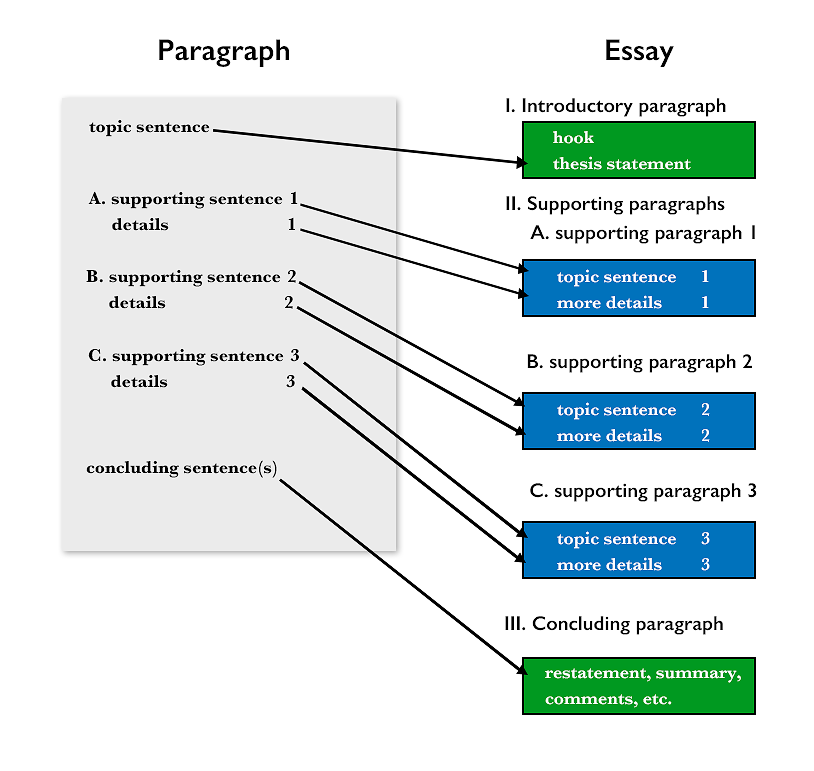
Attribution:
Building Academic Writing Skills. Harper College.
►Example Paragraph #1
"The experiment seemed straightforward and there were plenty of scientists willing to try it. Many did. It was wonderful to have a simple laboratory experiment on fusion to try after the decades of embarrassing attempts to control hot fusion. This effort required multi-billion dollar machines whose every success seemed to be capped with an unanticipated failure. 'Cold fusion' seemed to provide, as Martin Fleischmann said during the course of that famous Utah press conference, 'another route'--the route of little science."
from Harry Collins and Trevor Pinch, The Golem: What You Should Know About Science 2nd ed. (Cambridge: Canto, 1998), 58.
In this example, the first and last sentences in the paragraph are somewhat symmetrical: the authors introduce the idea of accessible science, contrast it with big science, and bring it back to the phrase "little science."
Attribution:
English Composition I. Schoolcraft College.
Attributions:
"Hack Your Academic Essay: Body Paragraph" Youtube, uploaded by Academic Education Materials, 30 May 2019, https://www.youtube.com/watch?v=mBn6emBHXH4
Permissions: YouTube Terms of Service
Here is a very basic template of a traditional paragraph.
*It is recommended to use at least one transition word within the paragraph.


To check your understanding, we invite you to submit your writing to the Online Writing Center via this online Writing Center LINK. The link will bring you to a form. In the form, you may put "Pre-Pals" for the COURSE NAME, "None" for the INSTRUCTOR, and "Unit 4 Body Paragraph Feedback" for the "Assignment Title." You will receive feedback from the Writing Center.

